


A Toronto refinance only helps when the new structure beats the current one after costs. Elisseos Iriotakis and the team at SafeBridge Financial Group start Toronto refinance files with the current mortgage statement, and the client’s current income situation, and help them calculate the mortgage break fee. Once it is determined that there will be interest savings, they move to a full mortgage application.
Equity take-out adds a second question: what the funds are for, and whether the remaining equity and income still qualify under current lender guidelines. Every lender is slightly different and this is where the team at SafeBridge helps clients navigate through the various lender policies. Midtown, North York, and Oakville homeowners often see marketing that skips those pieces. The first call should put them back in.
Break costs are part of the Toronto refinance math
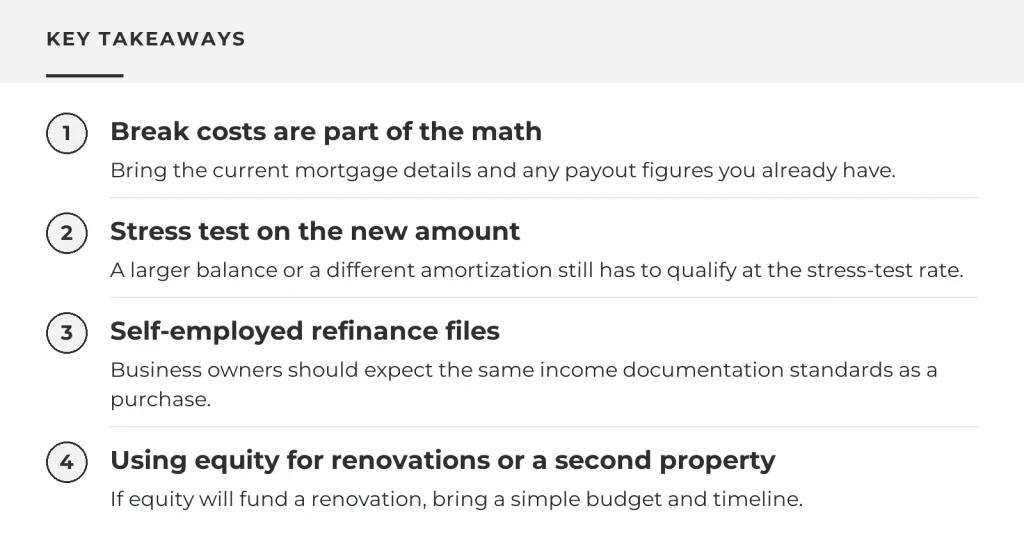
Leaving a term early can erase a rate win. Bring the current mortgage details and any payout figures you already have. The first call should compare staying put, blending if available, or a full refinance with honest costs included.
If you are within a few months of maturity, the comparison changes again. Sometimes waiting is cheaper than breaking. Sometimes the equity need cannot wait. Either way, the fee belongs on the same page as the new payment calculation.
Stress test on the new amount
A larger balance or a different amortization still has to qualify at the stress-test rate. Condo fees, taxes, and other debts count. SafeBridge mortgage agents will be able to assist in determining what the minimal appraisal value will need to be, and will be a key talking point that will determine if a refinance will make sense. We would hate to see good money being spent on an expensive appraisal, especially in the higher priced neighbourhoods like Rosedale, Oakville, Forest Hill and midtown Toronto, to name a few.
Amortization resets and longer terms can lower the contract payment while raising lifetime interest. The team will show both views so the decision is not only about the first year.
Self-employed refinance files
Business owners should expect the same income documentation standards as a purchase. Notices of assessment and business statements still matter. If last year’s write-offs crushed qualifying income, name that before shopping a cash-out number that cannot clear underwriting.
Recent dividend changes, a new corporation, or mixed personal and corporate debt need a clean explanation. Lenders differ on how they treat those files. Shopping without the story wastes time.
Using equity for renovations or a second property
If equity will fund a renovation, bring a simple budget and timeline. If it will support a Muskoka purchase or another investment, bring the second property details early. Two properties means two carrying-cost conversations, not one blended hope.
What to bring
Current mortgage statement, property tax information, income documents, and a clear reason for the refinance. If equity will fund a renovation or a second property, bring a simple use-of-funds outline. Recent condo documents help when the collateral is a unit rather than a freehold.
The goal is a structure that still qualifies after costs, not a screenshot of someone else’s rate. That is the standard SafeBridge uses before anyone talks about a firm closing date. If the numbers only work on a perfect appraisal and a perfect income year, that should be said before you sign.
Call (416) 466-5858 or visit safebridgefinancial.com to review your Toronto refinance file before you make an offer. Elisseos Iriotakis, SafeBridge Financial Group / TMG SafeBridge Mortgage Solutions Inc., FSRA brokerage license #10524. All mortgages subject to lender approval and qualification. This is not a commitment to lend.


 +1 (855) 466-5858